Bimonthly,
Launched in Dec. 2004 Supervised by Shanghai Library (Institute of Scientific & Technical Information of Shanghai, ISTIS) Organized by Shanghai Library (Institute of Scientific & Technical Information of Shanghai, ISTIS)
Shanghai Scientific and Technical Literature Press Published by Shanghai Scientific and Technical Literature Press Co-organized by Shanghai Society for Scientific and Technical Information Editor in Chief CHEN Chao Post Issue Code 4-904 ISSN 2095-8870 CN 31-2107/G3
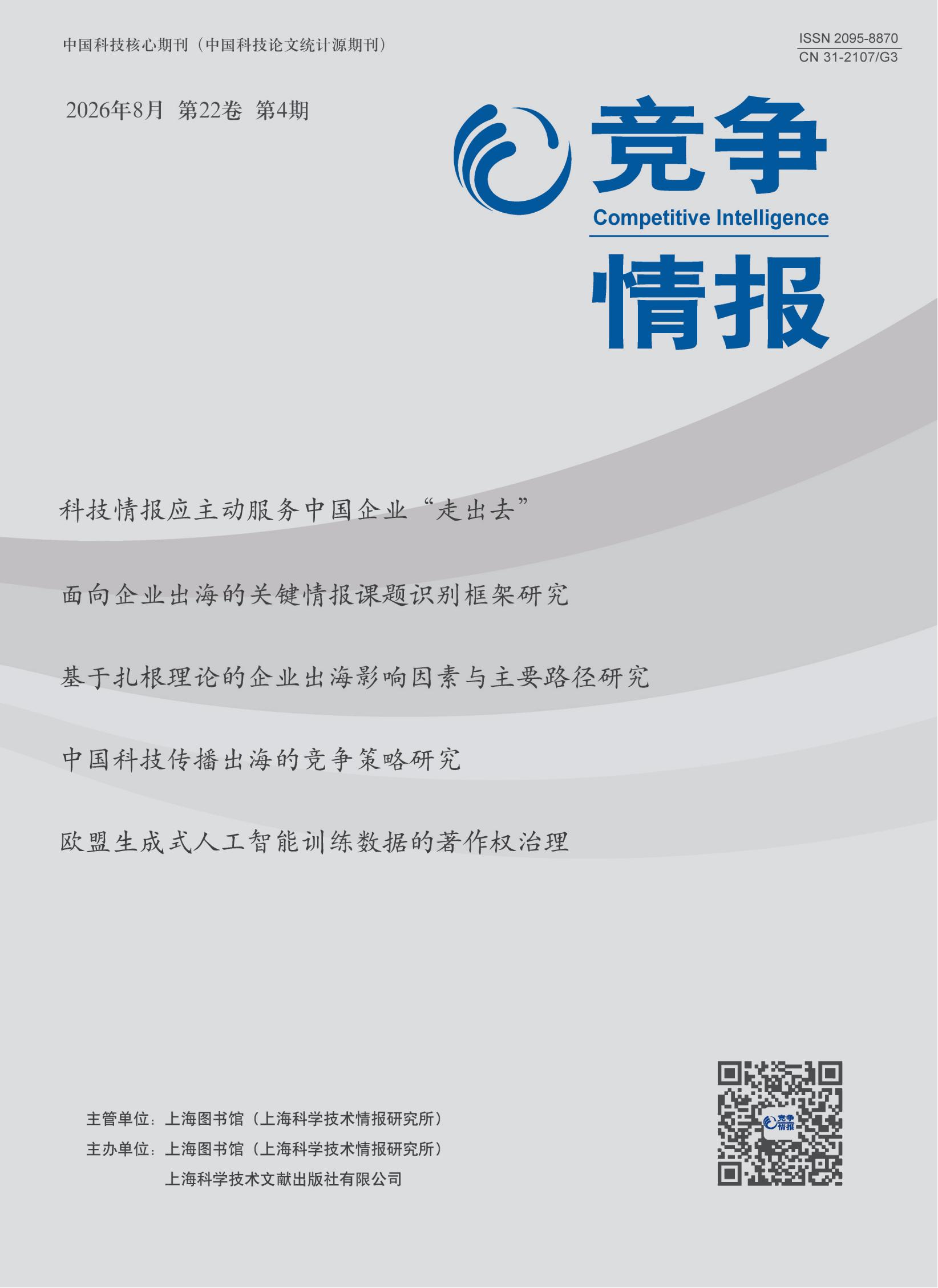
Against the backdrop of global industrial chain restructuring, the securitization of international competition, and the rapid advancement of digital technologies, the external environment that Chinese enterprises face when “going global” has become increasingly complex, with significant increase in uncertainties and risks.Traditional intelligence models—which primarily focus on gathering market information—are no longer sufficient to meet the needs of enterprises for overseas strategic decision-making, risk early warning, and compliant operations; thus, constructing a framework for identifying Key Intelligence Topics (KITs) specifically tailored to enterprises going global holds significant practical relevance. Based on typical application scenarios in overseas investment, market expansion, and international operations, this paper systematically identifies and synthesizes a representative KITs system for Chinese enterprises going global, centering on core requirements such as strategic decision-making, competitive monitoring, risk early warning, and compliance governance. The research focuses on areas including macro-environmental analysis of target countries and regions, market competition environment research, compliance management for market operations, and specialized investgation studies on investment decision-making in target markets. Furthermore, the study analyzes how factors such as geopolitics, industrial policies, data governance, international public opinion, and supply chain security influence the evolving enterprises’ intelligence requirements for going global. Building upon this foundation, the paper constructs a three-tiered, interlinked KITs identification framework—comprising “Scenario, Requirement, and Topic”—and proposes a logical structure and analytical pathway for organizing key intelligence for enterprises going global within dynamic risk environments. The aim is to enhance capabilities in strategic perception, risk identification, and international competitive resilience of enterprises’ overseas operations, thereby providing intelligence support and theoretical guidance for the global expansion of Chinese enterprises in the digital and intelligent era.
Based on grounded theory and intelligence research approach, this study constructs a “data-intelligence-decision” three-level research framework. Using China National Knowledge Infrastructure (CNKI),the Ministry of Industry and Information Technology, and local economic development bureaus as data sources.The research collects 623 journal papers and newspaper news, 32 policy briefs and related reports. Through a three-round coding system, we identify the influencing factors and their mechanism for cultural and manufacturing enterprises under the “borrowing a boat to go global” and “building a boat to go global” models, construct main overseas expansion path models and reveal the integration mechanism of multi-source intelligence and decision support logic in corporate overseas expansion strategies. Under the background of using global resources to enhance competitiveness and seeking new market opportunities. This study provides systematic intelligence work support for formulating corporate overseas expansion strategies. The results show: cultural enterprises’ “borrowing a boat to go global” is affected by five capabilities such as cultural symbol translation, and the path model consists of policy-driven layer, technology-driven layer, and collaborative governance layer. The “building a boat to go global” approach is affected by five capabilities such as autonomous cultural value outport, with a path model consisting of digital sovereignty construction layer, brand ecosystem construction layer, and rule reconfiguration layer. Industrial manufacturing enterprises’ “borrowing a boat to go global” strategy is influenced by four capabilities such as cooperative expansion, and the path model consisting of policy dependency layer, technology transfer layer, and asset-light penetration layers. The “building a boat to go global” strategy is constrained by four capabilities such as autonomous layout, and the path model consists of full industry chain localization expansion layer, technology- driven layer, and ecological control layer.
Against the backdrop of intensifying global technological competition, promoting the international outreach of science and technology communication has become an important path to enhance China’s scientific and technological influence as well as cultural soft power. Based on the new landscape of global technological competition, this paper expounds the strategic value of China’s science and technology communication going global. It selects four types of subjects—scientific research institutions, technology enterprises, scientific and technological journals, and self-media—as research objects, the study analyzes their overseas communication practices and indentifies competitive strategies centered on issue competition, scenario competition, discourse power competition, and attention competition. The aim is to provide theoretical reference and practical enlightenment for the development of China’s science and technology communication going global, and help elevate China’s global discourse power and international influence in science and technology area.
Overseas patent portfolio deployment for geothermal engineering project-related patents has become a focal point of international competition. This study systematically analyzes three distinctive attributes of such patents—geographic localization, integration, and credit worthiness. Drawing upon patent data, the findings reveal that China’s overseas patent deployment in this sector faces three core risks: strategic misalignment in geogrophic coordination, structural fragility in the technology chain, and dysfunctional credit transformation of patent assets. To address these risks, a synergistic strategy framework is constructed spanning three dimensions: institutional support, industrial coordination, and corporate capability. To counter strategic misalignment in geographic coordination, target-country-oriented directional support mechanisms and risk early-warning platforms are established to guide enterprises in precise, preemptive patent deployment. To remedy structural fragility in the technology chain, foreign-aid engineering mechanisms are reconstructed with integrated linkages between technical standards and patent licensing, collaborative industry-academia-research integrated patent portfolio deployment is promoted, and full-chain technology coverage is strengthened. To resolve dysfunctional credit transformation, cross-border patent financial credit enhancement instruments are created, geothermal patent alliances and collective credit operation mechanisms for patent assets are established, and enterprises are guided to leverage intellectual property finance. This study provides theoretical reference for enhancing the international competitiveness of Chinese geothermal engineering enterprises.
As one of the key production factors in the modern economic system, data elements are the driving forces of profound changes in productivity. The study and analysis of typical cases of “Data Element ×” can provide an overview of the data elements commercialization development in China and the empowerment effect of data elements on the new quality productive forces. This paper selects the 48 typical cases of “Data Element ×” published by the National Data Administration as the research object, analyzing the diversity and breadth of the typical cases in terms of industry fields, participating entities and application regions by using an econometric statistical method, reconstructing the multiplier effect of data elements empowering new quality productive forces from three dimencions: the production factors, science and technology, and the industrial structure. This paper finds that the typical cases cover 12 key industries, the participating units are divided into six types, and the applicant units are mainly distributed in East China and North China regions. Data elements play a multiplier effect in the new quality productive forces by supporting the innovative allocation of production factors, promoting revolutionary breakthroughs in science and technology, and enabling digital and intelligent transformation of industrial structure.
The rapid development of generative artificial intelligence has made the legality of using substantial quantities of copyright-protected works for large-scale model training a global governance challenge. This study takes recent cases such as Germany’s LAION case, GEMA v. Open AI case, and the Netherlands’ DPG Media case as entry points, and employs a combined methodology of case study and comparative analysis to systematically deconstruct the judicial application logic of the text and data mining exception in the context of AI training under the EU Directive on Copyright in the Digital Single Market. The research finds that while EU judicial practice recognizes, on a case-by-case basis, the applicability of the text and data mining exception, significant divergences exist among rulings on core issues such as the validity of the rightsholder’s “opt-out” mechanism, the legal characterization of reproduction in model training, and the standard of “machine-readability,” presenting two distinct judicial approaches, with a clear divide between one that accommodates technological development through flexible interpretation and another that seeks to regulate emerging technologies by applying traditional legal concepts. Meanwhile, the administrative compliance framework established by the Copyright Chapter of the General-Purpose AI Code of Practice forms a functional complement to existing judicial rules, yet also gives rise to coordination challenges. The EU’s practice demonstrates that AI training data copyright governance requires coordinated progress across three dimensions: institutional design, judicial adjudication, and regulatorycoordination.



 Abstract
 Download PDF
